
For parents, coaches, and young athletes
Mental toughness for young athletes.
Mental toughness isn’t a trait some kids are born with. It’s a trainable response system — what an athlete does after the play didn’t go their way. This guide is the practical, non-clinical playbook: drills, scripts, a 4-week plan, and how to measure progress without surveillance.
Key takeaways
- Mental toughness in youth sport is recovery speed after a mistake, attention control under stress, and holding standards when no one is watching — not a personality trait.
- It is trained by exposure in small structured doses during practice, not by shielding an athlete from pressure until game day.
- Match the work to the age: 6–9 build try-again defaults, 10–12 build routines and cues, 13–15 build pressure response, 16–18 build standards and identity outside the sport.
- Four weeks — awareness, reset speed, self-talk, pressure exposure — at roughly twenty minutes a day is enough to see a change in response.
What mental toughness really means in youth sports
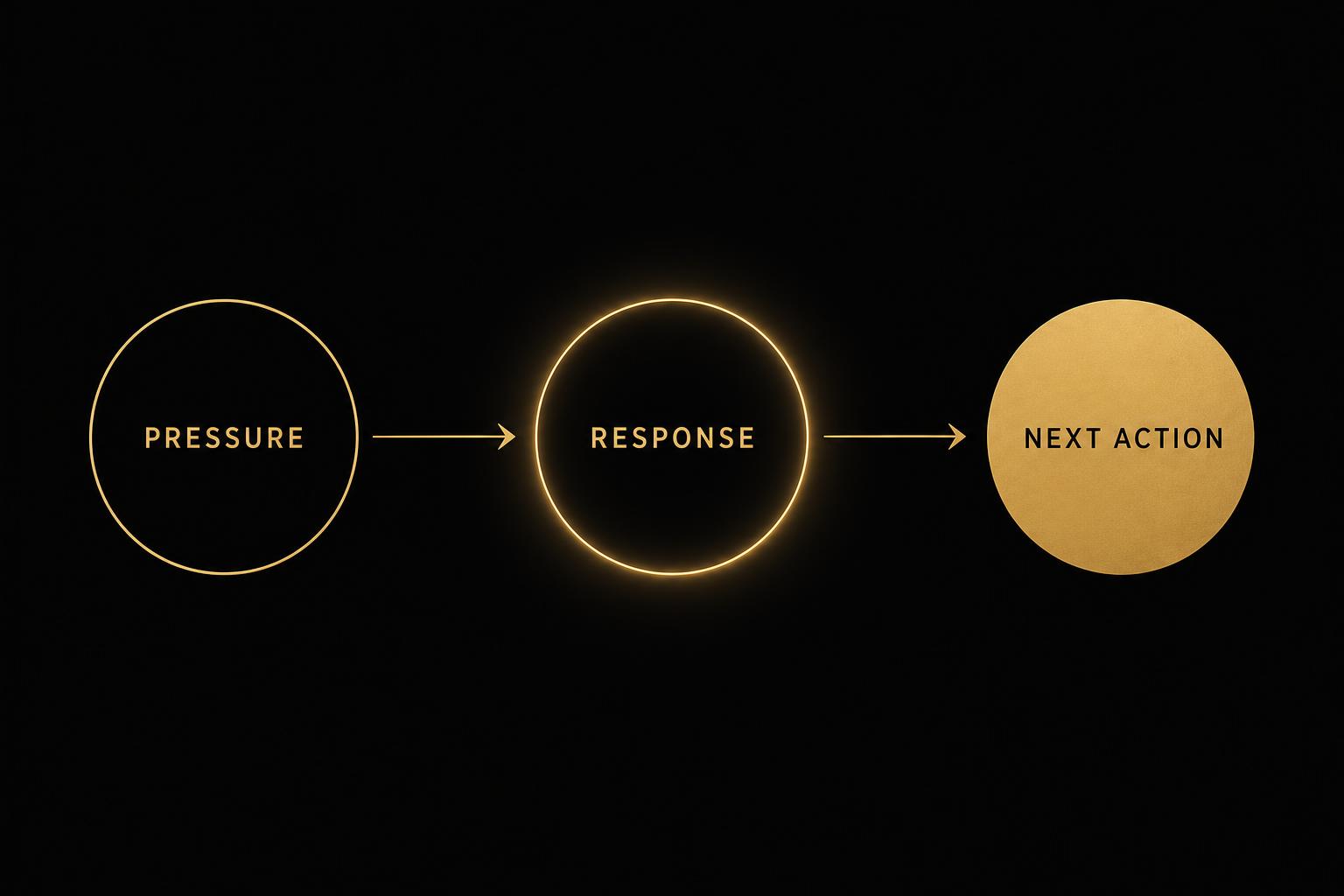
Mental toughness, for a 9–18 year old, is the ability to execute the next play after the last one didn’t go their way — and to keep executing as the game tightens. It is not yelling at yourself harder. It is not hiding emotion. It is not a personality trait.
The core belief: pressure doesn’t create a new athlete — it exposes the response system already in place. The job is to train that system, on purpose, before the game forces the answer.
Working definition
Mental toughness = recovery speed after mistakes + attention control under stress + the willingness to keep executing standards when no one is watching.
Mental toughness by age and stage
What helps a 7-year-old does not help a 17-year-old. Match the training to the developmental window — and refuse to train what the athlete isn’t ready for.

Ages 6–9
Train: Try-fail-try cycles. Naming feelings. Effort over outcome. Make trying again the default.
Avoid: Performance metrics, score-driven praise, video review.
Ages 10–12
Train: Pre-shot routines. Simple breath resets. One-word self-cues. Reflection without grading.
Avoid: Public ranking, comparing to teammates, post-game technique replays.
Ages 13–15
Train: Pressure exposure in practice. Response to mistakes. Honest self-reporting. Communication under stress.
Avoid: Diagnosing personality. Tying identity to a single position or stat line.
Ages 16–18
Train: Standards, leadership, recovery routines, identity outside the sport. Plan for adversity, not just success.
Avoid: Toughness theater. Public callouts. Pretending injuries — physical or mental — aren’t real.
Five principles that actually help
- 01
Skills, not personality
Mental toughness is a trainable response system — confidence, focus, composure, recovery, communication — not a fixed trait some athletes are born with. Treating it as personality is how young athletes get labeled and stuck.
- 02
Process language, not outcome language
Coaches and parents who consistently name effort, decisions, and standards build athletes who can keep playing after the scoreboard turns. Outcome-only feedback teaches an athlete that they only matter when they win.
- 03
Exposure beats avoidance
Pressure response is built by training in pressure — small, structured doses in practice — not by being shielded from it until game day. The first time an athlete feels real pressure should not be in the final minute of the championship.
- 04
Recovery speed is the real metric
The question isn’t whether a young athlete will make a mistake. They will. The question is how fast they can reset to the next play. Recovery speed is the most honest indicator of mental toughness at any age.
- 05
Safety guardrails come first
Healthy youth sport rests on consent, age-appropriate exposure, qualified adults, and access to licensed providers when concerns go beyond performance. Organizations like the U.S. Center for SafeSport and the American Academy of Pediatrics publish standards parents and clubs should know.
Drawn from published youth-sport guidance (AAP, CDC HEADS UP, U.S. Center for SafeSport) and the IBE coaching model. None of this replaces clinical care — see the safety section below.
Three practical drills
Athletes can start these tomorrow. Coaches can run them in any practice. No equipment, no jargon.
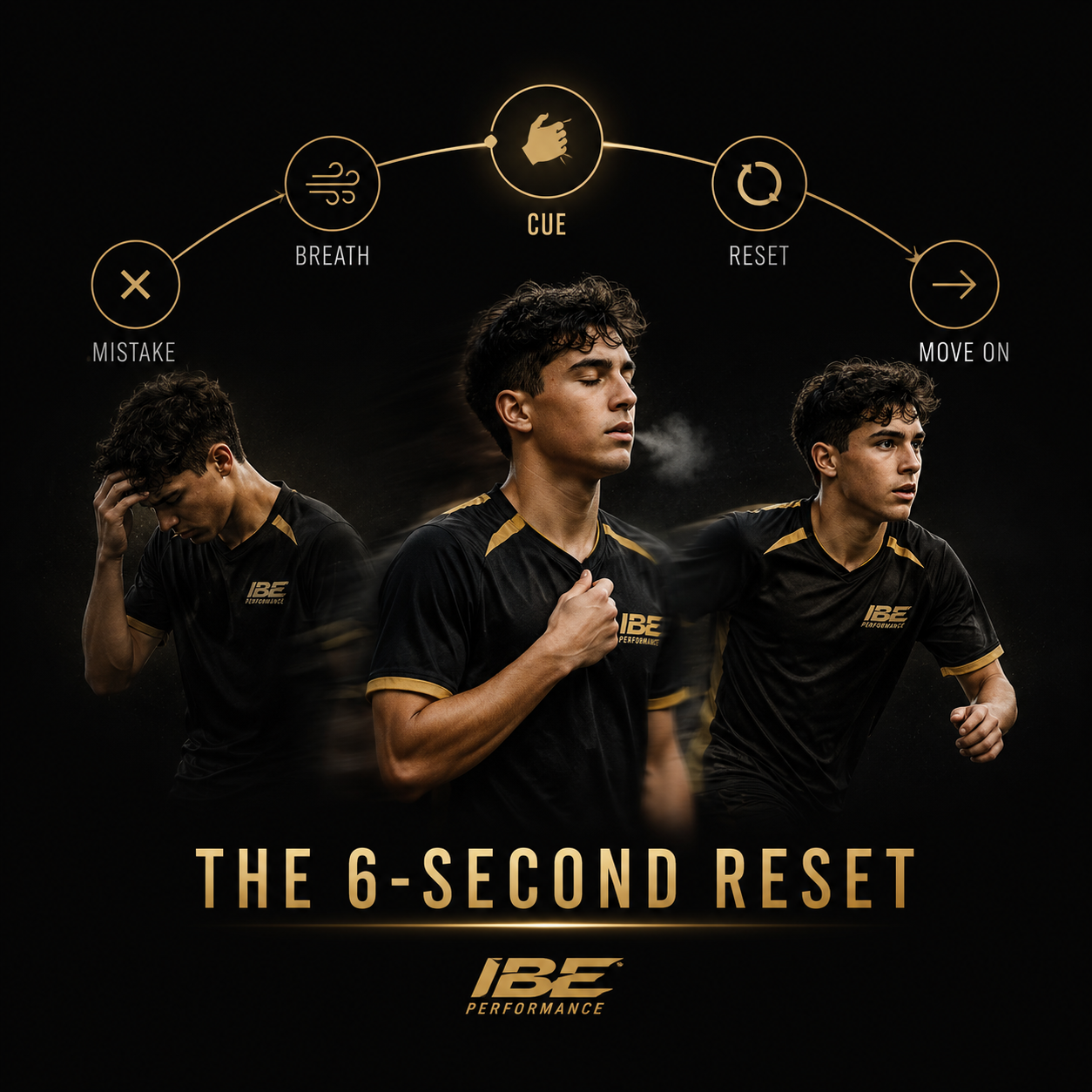
The 6-second reset
When · Right after a mistake.
Long exhale. Touch a marker on the body (wrist, jersey). Say one word: ‘Next.’ Eyes up. Move on.
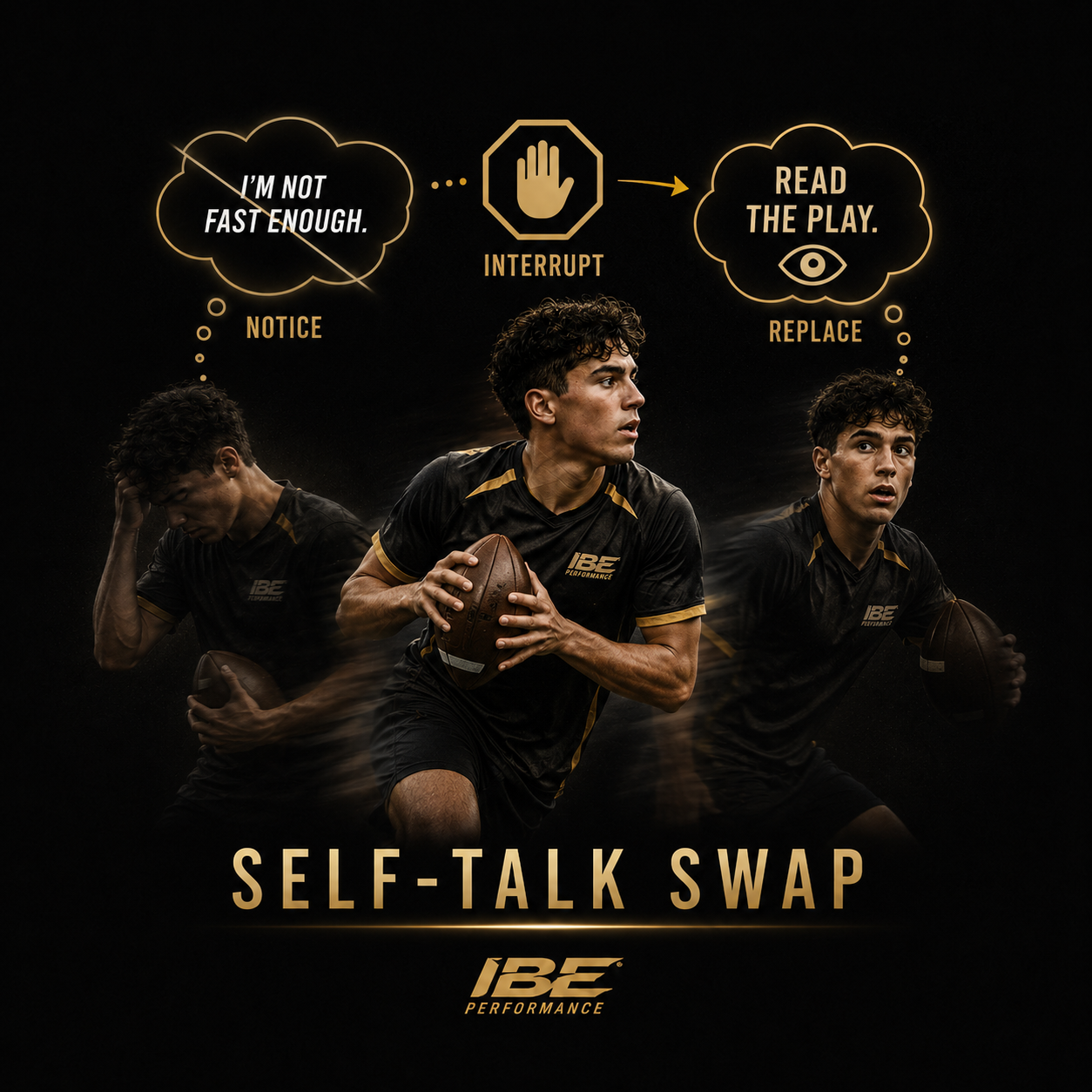
Self-talk swap
When · When the inner voice gets loud.
Notice the script (‘I always choke here’). Interrupt it. Replace with a cue tied to the next action (‘Read the play.’). Repeat until the cue lands first.
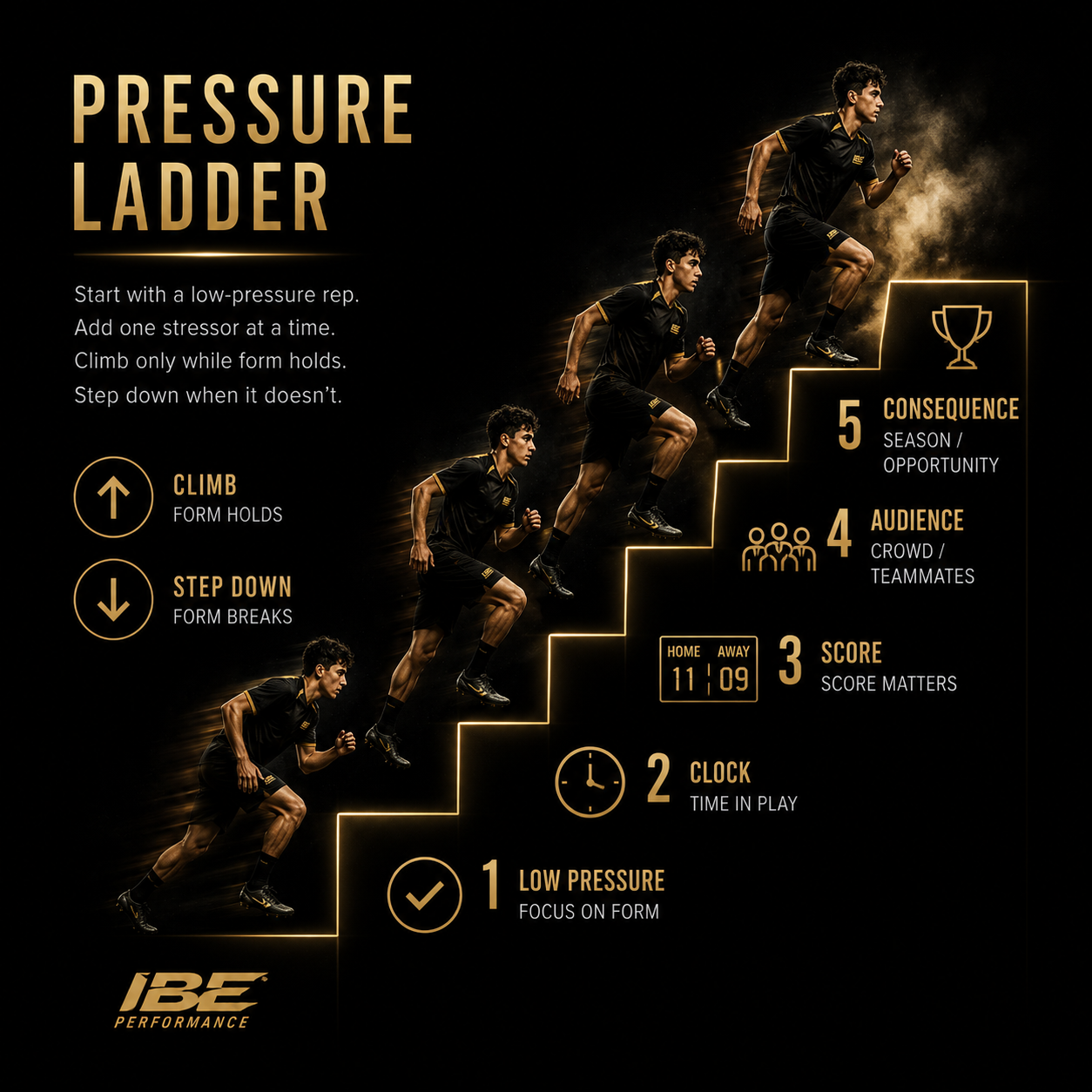
Pressure ladder
When · In practice — not on game day.
Start at a low-pressure rep. Add one stressor per round (clock, score, audience, consequence). Climb only as long as form holds. Step down when it doesn’t.
Parent and coach scripts for tough moments
The post-game car ride and the mid-game huddle are the two highest-leverage moments most adults waste. Use these scripts. Keep it short.
For parents — after the game
- “I love watching you play.”
- “What is one thing you’re proud of from today?”
- “Is there anything you want to talk about, or do you want quiet?”
- Don’t coach. Don’t replay. Don’t diagnose.
For coaches — mid-game reset
- “Eyes up. Breath. One play at a time.”
- “Communicate. Next rep.”
- Use after momentum swings — never as punishment.
- Save technical breakdown for film, not the locker room.
Printable script cards and the weekly check-in are available — ask during your review.
A simple four-week plan
One focus per week. Twenty minutes a day. The point is consistency, not intensity.
| Week | Focus | Daily drill | Weekly check |
|---|---|---|---|
| Week 1 | Awareness | Daily 60-second debrief: one win, one reset, one cue for tomorrow. | Did I notice my response before reacting? |
| Week 2 | Reset speed | 6-second reset in every practice rep after any mistake. | How fast did I get to the next play? |
| Week 3 | Self-talk | Self-talk swap — write the cue card before practice; review after. | Did my cue land before my old script? |
| Week 4 | Pressure exposure | Two pressure-ladder reps per session. Coach or parent adds one stressor. | Did form hold? Where did it break? |
How to measure progress without surveillance
Mental toughness is measurable — but the measurement should belong to the athlete, not the parent. The IBE Scorecard is taken by the athlete; what they share is up to them. Adults see progress signals, never private answers.
Track three things over four weeks: how fast the athlete resets after mistakes, how often they execute the cue they wrote down, and whether their self-report stops swinging with the scoreboard. That’s real progress. The rest is noise.
See the full IBE framework →When it isn’t a mental toughness problem
- Persistent sadness, hopelessness, or withdrawal that lasts beyond a single tough stretch.
- Disordered eating, sleep collapse, or self-harming behavior.
- Sudden personality change, panic that doesn’t resolve, or talk of self-harm.
- Coach, teammate, or adult conduct that crosses safety boundaries.
These are not performance problems — they are clinical, safety, or safeguarding concerns. Contact a licensed mental-health provider, your pediatrician, or the U.S. Center for SafeSport as appropriate.
If anyone is in immediate danger, call 911. In the United States, you can also reach the 988 Suicide & Crisis Lifeline anytime.
Understand the pattern. Train what matters.
Start with a conversation about what is happening under pressure and what needs to change. If measurement would improve the diagnosis, a Scorecard or Full Profile can be added afterward.
FAQ
What age is this for?+
Youth through college. Most parents start asking around ages 12–18, when results begin to matter and pressure shows up in ways practice didn’t predict. The drills scale down to ages 9–10 with adult support.
Is this therapy or counseling?+
No. IBE is coach-led mental performance training, not therapy, counseling, diagnosis, or clinical treatment. If clinical concerns appear, a referral to a licensed provider is recommended.
How is mental toughness different from grit?+
Grit is sustained effort over years. Mental toughness is the next-play response under pressure. Both matter; they’re trained differently.
Will my athlete know I signed them up?+
Yes — the athlete takes the Scorecard themselves. The result belongs to them. Parents see progress signals, not private answers.
Does this work for any sport?+
Yes. The skills trained — confidence, focus, composure, coachability, communication, execution — transfer across sports.
What does a results session look like for a young athlete?+
A coaching conversation about the Full Profile. Age-appropriate language. Phil walks through what the data means in competition and gives a private next-step recommendation. It is performance coaching, not therapy.
How is this different from a sports psychologist?+
Sports psychologists and licensed mental-health providers offer clinical services. IBE is a coach-led performance training system built around measurement. Different jobs — not in competition.
Related reading
- For parentsHow to support a competitive athlete without adding pressure.Read
- What to say after a bad gameThe car-ride conversation, rewritten.Read
- Parent guide to mental toughnessWhat is age-appropriate to train, and what is not.Read
- Mental health vs. performance coachingWhere performance coaching ends and clinical care begins.Read