
Parent Support
Can Mental Performance Coaching and Therapy Work Together?
Parents do not always need to choose between performance coaching and therapy. The first question is which needs require which professional.
By Philip Coffman · Founder, iBE Performance ·
Yes. A teen athlete can sometimes work with both a mental performance coach and a licensed mental-health professional when their roles are clear, the athlete is willing, and collaboration respects consent and confidentiality. These services are not interchangeable.
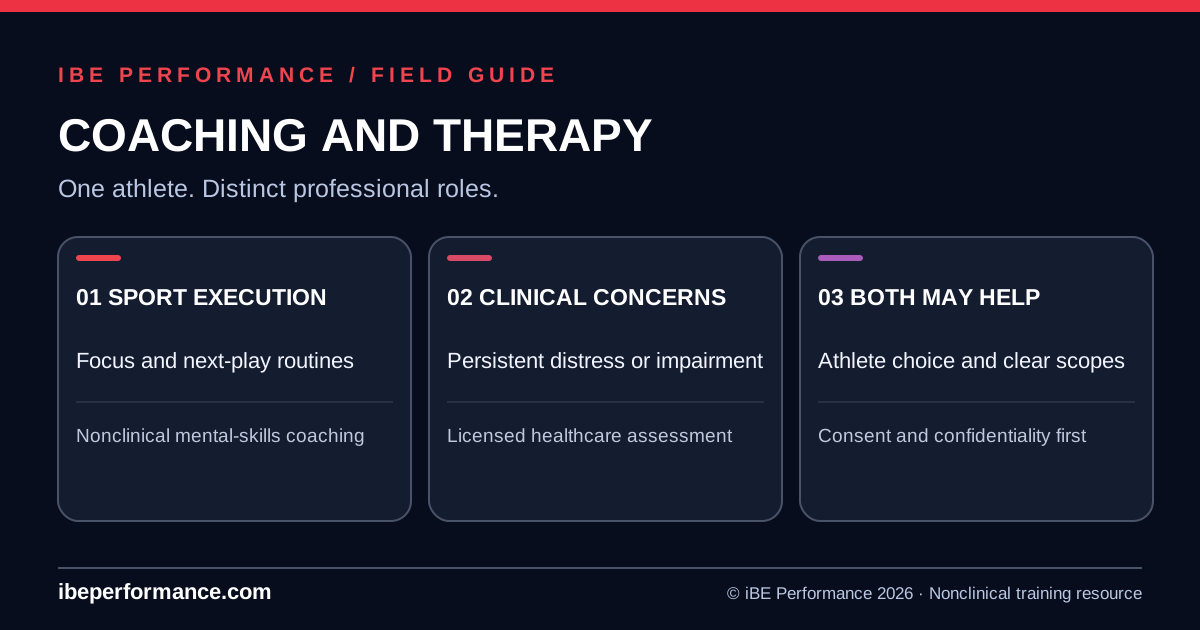
Mental performance coaching teaches nonclinical skills for focus, routines, communication, confidence, and executing under pressure. Therapy addresses psychological symptoms and clinical concerns within a licensed provider's competence. A coach cannot decide whether a child has a mental-health disorder.
Three Questions to Sort Out the Right Starting Point
1. Is the immediate goal a specific sport behavior such as refocusing after an error? Performance coaching may be appropriate if the athlete wants it and clinical concerns are not being overlooked.
2. Is the young person experiencing persistent distress or problems involving sleep, eating, school, relationships, functioning, or safety? Seek a licensed health professional's assessment rather than relying on a sports mindset program.
3. Is there both a performance goal and a clinical concern? A licensed provider can address clinical needs while performance skills may be complementary if appropriate. An athlete should not be pressured to disclose private therapy details to coaches.
A Parent Boundary Checklist
Before selecting any provider, ask about training and professional scope, how concerns are referred, how progress will be evaluated, and what information may be shared with parents or sport staff. Legal confidentiality rules vary by jurisdiction, provider type, setting, and the athlete's age.
Avoid services that promise to 'cure anxiety' through mental toughness training, imply an assessment is a diagnosis, or require a young athlete to buy a package before the problem is understood.
- Ask who delivers the service and which credentials can be verified.
- Ask whether sessions are coaching, licensed therapy, or another service, and what each provider will not do.
- Ask how consent, minor safeguarding, parent participation and privacy are explained.
- Ask how goals are decided by the athlete and what observable progress would look like.
- Ask what happens if a clinician becomes necessary.
What Collaboration Could Look Like
A licensed clinician might address persistent distress while the athlete separately practices a sport-specific attention or pre-performance routine with a mental performance coach. Any communication between providers should be limited to what is appropriate and authorized.
A school counselor, physician, guardian, or team coach may have different roles. Nobody should treat a young person's private care as information automatically available to the athletic department.
A Nonclinical Example: Recovering After a Mistake
A young athlete who wants to improve their next-play response may identify a cue, rehearse it at practice, and record whether they returned to their task after an error. That is a skills exercise, not a treatment for a mental-health condition.
If distress is persistent, worsening, or unsafe, prioritize qualified clinical help. In an immediate safety emergency, contact local emergency services or the appropriate crisis resource.
Frequently Asked Questions
Mental Performance Coaching FAQ
Can an athlete receive coaching and therapy at the same time?
Sometimes, yes. Both providers must stay within their scope, and collaboration requires appropriate consent and confidentiality safeguards.
Is a free mental performance scorecard a clinical test?
No. IBE's scorecard is a self-report coaching reflection and must not be used to diagnose, screen for, or rule out a mental-health condition.
Turn This Guide Into a Practical Plan
Build a response for your actual performance environment.
Start with a focused consultation to discuss your specific situation, determine fit, and identify the right next step. If measurement would add useful evidence, an assessment can follow the conversation.
More Guides Like This
Parent Support
An immediate technical breakdown after a difficult competition can turn a car ride into another evaluation setting instead of a supportive relationship. Try the original IBE Choice-First Post-Game Conversation exercise, with complete steps and research references.
Coachability
Mental performance coaches, sports psychologists, sport coaches, and athlete mentors can all support performance, but they do different jobs. Use the problem, scope, and athlete's needs to choose the right fit.
Mental Performance
Mental health support and mental performance training solve different problems. Athletes need to know which one they're actually looking for.