
Leadership & Personal Development
Executive Mental Performance: Better Decisions Under Pressure
High-stakes leadership demands clear decisions and reliable handoffs. Use a repeatable perception–decision–execution routine instead of relying on willpower.
By Philip Coffman · Founder, iBE Performance ·
Executive mental performance coaching helps leaders practice the attention, communication, and decision behaviors they need when stakes rise. It is not therapy, outsourced HR, or a guarantee of business outcomes.
Consider a familiar scenario: a leader faces a shortened deadline, conflicting recommendations, and a customer waiting for an answer. 'Stay calm' is not an actionable system. Clarifying what is known, who decides, and what happens next is.
What Is Executive Mental Performance Coaching?
It is nonclinical behavioral skill development for the performance demands of leading: focusing on the next important action, making decisions with incomplete information, giving feedback under pressure, and recovering after a mistake. These are observable workplace behaviors, not personality diagnoses.
An individual leader may need a reliable cue before a board presentation. A leadership team may need a shared decision handoff. The appropriate intervention depends on the actual bottleneck.
The IBE Four-Step High-Stakes Decision Rehearsal
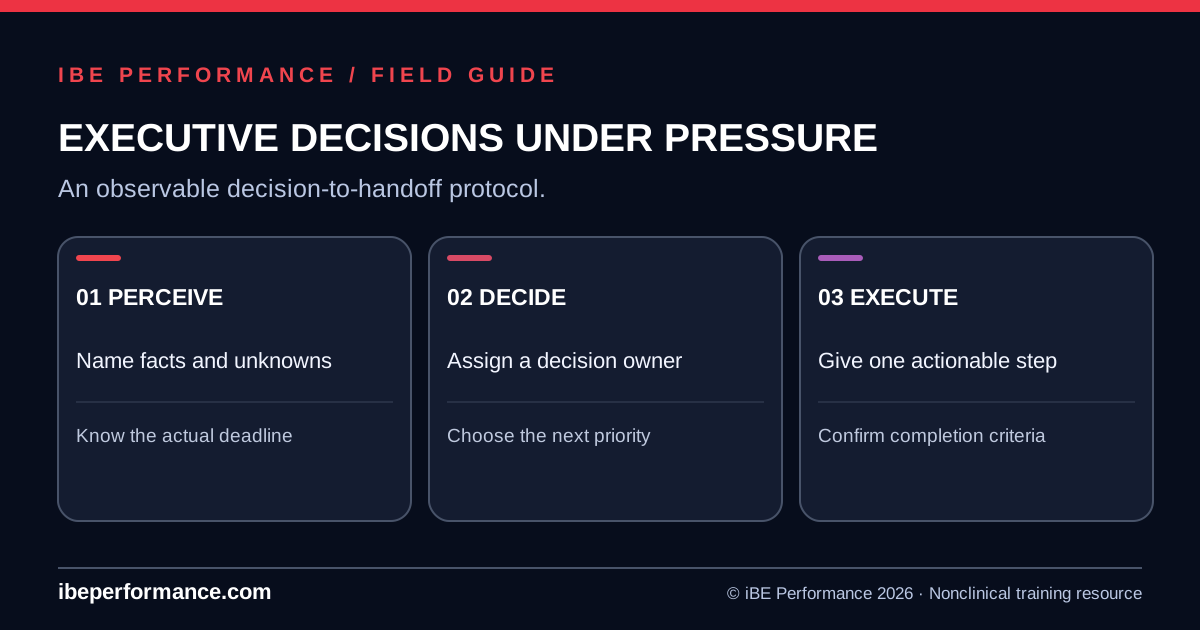
I use the perception–decision–execution (PDE) lens to make one pressured moment teachable. Practice this with a low-risk decision before applying it to consequential choices.
- Perception: name three observable facts, one important unknown, and the real deadline. Separate evidence from interpretation.
- Decision: identify what is important now, the available options, the decision owner, and the tradeoff that matters.
- Execution: specify the next action, its owner, a completion standard, and a time to review progress.
- Handoff: ask the receiving person to restate the commitment and escalation trigger. Correct mismatches before work starts.
What to Do When Decision Fatigue Is Rising
Narrow attention to one controllable next decision rather than trying to control every consequence. In IBE language, WIN means What's Important Now. It is a task-selection cue, not a claim that every stress response can be suppressed.
Sustainable performance also requires reasonable workloads, rest, and appropriate organizational support. A short reset routine cannot compensate for chronic exhaustion or unsafe conditions.
How to Measure the Process Instead of the Motivation
For one recurring decision type, record baseline time to assign ownership, whether the receiver can accurately restate the task, and how often decisions reopen without new evidence. Rehearse the process and compare similar situations later.
Do not judge success from a single workshop or claim the exercise increases revenue by a fixed percentage. Changes may reflect staffing, deadlines, or the difficulty of decisions.
When to Choose Individual Coaching Versus Team Facilitation
Individual coaching makes sense when a leader wants to train a specific attention, presentation, decision, or feedback routine. Organization-level facilitation fits recurring problems in cross-functional handoffs, team communication, or shared standards.
I work directly with clients to determine an appropriate nonclinical scope and whether the outcome can be observed in real work.
Frequently Asked Questions
Mental Performance Coaching FAQ
Can mental performance coaching help a leadership team?
It can help a team rehearse specific decision, communication and handoff behaviors. Results should be evaluated against actual work rather than assumed from attendance.
Is executive mental performance coaching psychological treatment?
No. iBE provides nonclinical performance coaching; diagnosis and mental-health treatment belong with appropriately licensed professionals.
Turn This Guide Into a Practical Plan
Build a response for your actual performance environment.
Start with a focused consultation to discuss your specific situation, determine fit, and identify the right next step. If measurement would add useful evidence, an assessment can follow the conversation.
More Guides Like This
Leadership & Personal Development
A practical three-part information handoff leaders can rehearse to clarify facts, decision owners, and follow-up during high-pressure business situations.
Pressure Response
During a client escalation, teams may confuse urgency with clarity. Ownership, information and the next decision can fragment under pressure. Try the original IBE Decision-to-Action Handoff exercise, with complete steps and research references.
Team Culture
Self-awareness gets more useful when teams compare intention, interpersonal impact, and observable evidence—then train the gap instead of arguing over who is right.